
Why Industrial AI for Manufacturing must progress from Visibility to Orchestrated execution
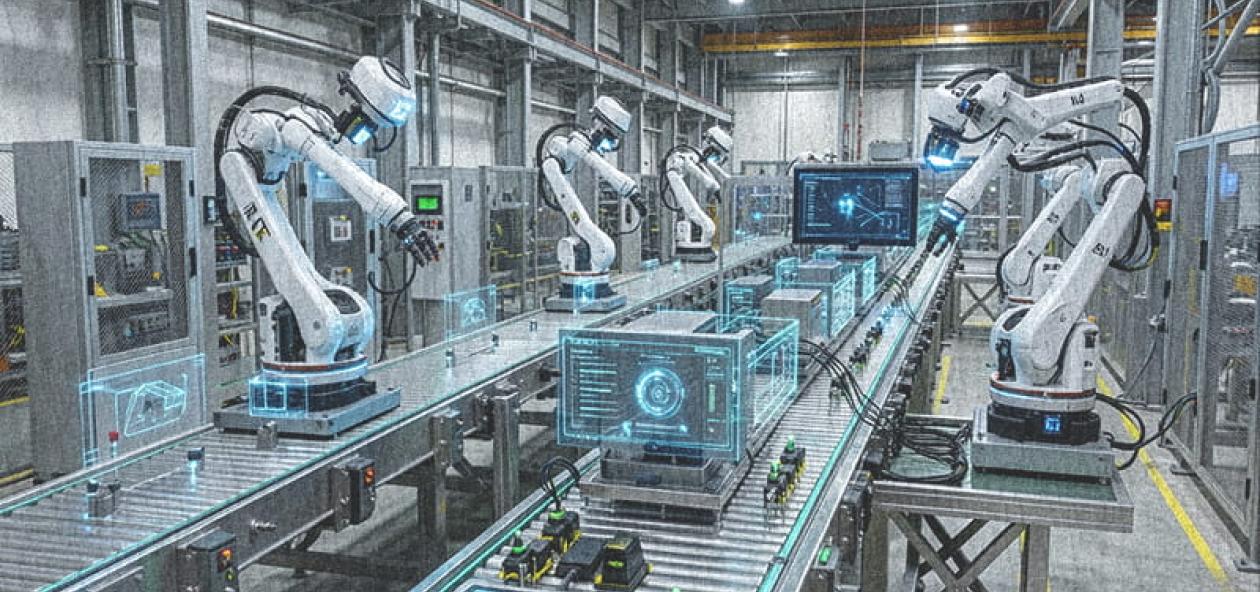
Industrial AI that stops at alerts and dashboards leaves the hardest problem unsolved. Learn how the shift to integrated workflow visibility, AI-driven orchestration, and closed-loop execution creates real operational value.
Manufacturers today aren't lacking data. They aren't lacking alerts. Many aren't even lacking dashboards.
What they're lacking is a system that closes the gap between seeing a problem and orchestrating a response to it.
Industrial AI has delivered real progress on the visibility front. Predictive maintenance can flag equipment risk before a failure occurs. Anomaly detection catches quality deviations early enough to correct course. Inventory intelligence surfaces supply chain risks before they become production problems. These are genuine advances - and they represent the foundation of what AI in manufacturing should do.
But a foundation isn't a finish line.
Most manufacturing AI deployments today stop at the same place: an alert fires, a dashboard updates, and someone somewhere in the organization has to figure out what to do next. That handoff - from machine-generated insight to coordinated human action is where most of the potential gets lost, and where AI investments tend to quietly underperform.
The real cost of Alert-Only AI
Alert saturation is now one of the most commonly cited challenges in industrial operations. Teams managing multiple systems, competing priorities, and lean staffing simply cannot act on every notification with the speed and consistency the AI intends.
The problem isn't the people - it's how these systems are built.
When AI systems are built to observe and report but not to integrate or orchestrate, they can create more overhead than they eliminate. Engineers spend time triaging notifications instead of resolving issues. Planners receive risk flags that require five more systems to act on. Supervisors see the alert but lack the context to know which response takes priority, or which team is supposed to own it.
What you end up with is sophisticated detection and inconsistent outcomes. AI can predict a failure, but whether that failure is actually prevented depends entirely on what happens after the alert fires. And without orchestration, there's no consistent playbook for what comes next.
From Dashboards to Workflow Visibility: The next level
The step beyond alerts isn't more alerts. It's visibility that's connected to how work actually flows - and designed to support the orchestration of a response.
There's a meaningful difference between a dashboard that shows you operational data and a system that shows you where in the workflow an issue is occurring, which teams are affected, what decisions are pending, and what the downstream impact will be if nothing changes. One gives you a signal. The other gives you the foundation for coordinated action.
Integrated workflow visibility means AI isn’t layered on top of your operations; it’s embedded within them. An anomaly isn’t just detected; it’s mapped to the specific sensor, machine, line, shift, and process it belongs to. A supply risk gets surfaced in the context of current orders, production schedules, and supplier lead times - not as a standalone flag that someone has to go investigate.
This level of visibility doesn't just make the alert more informative. It makes orchestration possible because the person receiving the insight now has the full operational context they need to act, rather than spending 30 minutes pulling it together from multiple systems.
From Visibility to Recommended Actions: Closing the interpretation gap
Workflow visibility solves the context problem. But there’s a second gap that’s just as costly: the interpretation gap. And that’s where the role of orchestration becomes clear.
Even when a team understands what's happening and why, determining the right response takes time. A planning manager who receives a supply risk alert still has to evaluate sourcing options, assess their impact on production schedules, and decide which mitigation approach makes the most sense - often without any guidance from the system that generated the alert in the first place.
AI-recommended actions close this gap by moving the system from passive observation to active guidance, and from context delivery to orchestrated direction.
Instead of simply flagging an inventory shortfall, the system provides the recommended response: initiate a replenishment order with this supplier, adjust this production run, escalate to this stakeholder. Instead of just detecting equipment degradation, the system recommends a specific maintenance window that minimizes production disruption, pre-assigns the relevant technician, and flags any parts that need to be staged.
The insight and the guidance travel together, the orchestration logic is built in, and the time from detection to coordinated response is significantly reduced. Operators spend less time chasing context and more time acting on it.
From Recommendations to Execution: Where orchestration becomes outcomes
AI-recommended actions are powerful. But recommendations that don't move into execution are just better-formatted alerts. What bridges that gap is orchestration - the coordination layer that routes actions to the right people, through the right systems, in the right sequence.
The final and most impactful shift is when the system doesn't just provide a recommendation - it puts the response in motion. That means recommended actions are embedded into the existing workflows and tools your team already uses. It means ownership is assigned, not assumed. It means progress is tracked, outcomes are recorded, and if something stalls, the system escalates before it becomes a missed deadline.
Here is an example of how this plays out:
A potential inventory shortage is detected. The system identifies the risk, recommends a replenishment action, and orchestrates the response, routing the action to the appropriate planner within the ERP, tracking completion, and flagging if the resolution window is closing. The planner doesn't have to locate the right system, assemble the context, or determine the approval path. The orchestration layer handles the routing and sequencing. The planner handles the judgment call.
The outcome isn’t just awareness of a risk - it’s a resolved risk, with a documented trail showing what was done, who did it, and when.
Why this progression matters for manufacturing leaders?
The manufacturing industry isn't struggling with a lack of data. It's struggling with converting that data into consistent operational performance. In most cases, the missing ingredient is orchestration.
As production environments grow more interconnected - spanning global suppliers, distributed assets, and increasingly complex customer requirements - the competitive advantage no longer relies on having better information. It relies on orchestrating action on that information faster and more consistently than the competition.
Organizations that remain at the alert-and-dashboard stage will keep running into the same challenge: insights generated, actions delayed, outcomes inconsistent. Those that move toward integrated workflow visibility, AI-guided orchestration, and execution-connected AI will find that the ROI of their AI investments finally starts to reflect the operational improvements they were expecting.
The practical test of AI success isn't model accuracy or alert volume. It's whether the insight was orchestrated into an action - and whether that action improved the outcome.
How TruMetric enables the full progression
TruMetric is built on the premise that visibility without orchestration and execution is incomplete. Our platform embeds AI directly into manufacturing workflows - not as a separate reporting layer, but as an integrated part of how decisions get made, actions get orchestrated, and outcomes get delivered.
Contextual visibility: Insights surface within the operational context where they're relevant, connected to the workflows and systems teams already use
AI-guided next steps: Recommended actions are generated alongside insights, reducing the interpretation burden on operators and planners
Orchestrated response: Actions are routed to the right people and systems automatically - with clear ownership, sequencing, and escalation paths built in
Closed-loop execution: Actions are tracked from initiation to resolution, with a documented record of what was orchestrated, who acted, and what was achieved
The result is Industrial AI for manufacturing that doesn't just inform - it orchestrates and executes.
Final thoughts
Manufacturers don't need more alerts. They need systems designed to ensure that every critical insight is orchestrated into a timely, accountable action.
The path is a progression: from alerts, to workflow visibility, to AI-recommended actions, to orchestrated execution that closes the loop. Each stage builds on the last. And most organizations are significantly earlier in that progression than their AI investments suggest they should be.
The future of industrial AI isn’t about how well a system detects problems. It’s about how effectively it turns those detections into coordinated, resolved outcomes - reliably and at scale.
That’s where the real return on investment actually shows up, and it’s where manufacturing AI still has the most ground to cover.
TruMetric connects manufacturing intelligence with orchestrated execution. [Learn how we help manufacturers move from alerts to outcomes.]