
Can Industrial AI Solutions Work Across Manufacturing Operations?
Industrial AI in manufacturing should not be an experiment. Learn how to move beyond AI pilots to real-world manufacturing operations solutions that stabilize production, optimize inventory, and protect your margins.
It’s a fair question, and one most manufacturers have asked after sitting through enough strategy and vendor presentations.
Let’s start with an uncomfortable truth. Many Industrial AI programs are built backwards.
They begin with technology models, platforms, and architectures first and only later ask how people running day-to-day operations will actually use them. The result is familiar:
Dashboards on plant floors show what is happening currently - that day/hour/minute
Alerts that fire constantly but don’t tell anyone what to do
Predictions that live in planning tools while execution teams operate blind
“AI pilots” that never scale beyond one line or one plant
“AI Pilots” that don’t provide integrations from shop floor to backoffice
What this really means is that AI is forced to fit into existing silos instead of stitching them together.
In manufacturing operations, work doesn’t happen in silos; everything is connected in some way or another. Planning decisions affect production. Production behavior affects quality. Quality issues ripple into inventory, suppliers, and customers. When AI only optimizes one slice, the rest of the system loses coordination and visibility.
So, can Industrial AI work across manufacturing operations? It can, but only when it is designed for how operations run. The sections below break down where Industrial AI in production environments delivers true value, and where it usually fails.
When Industrial AI works…
..it doesn’t feel experimental, it feels dependable.
The value isn’t flashy automation. It’s knowing what’s happening and what’s expected to happen across lines and plants early enough to protect expected throughput, service levels, and margin.
In practice, that shows up like this:
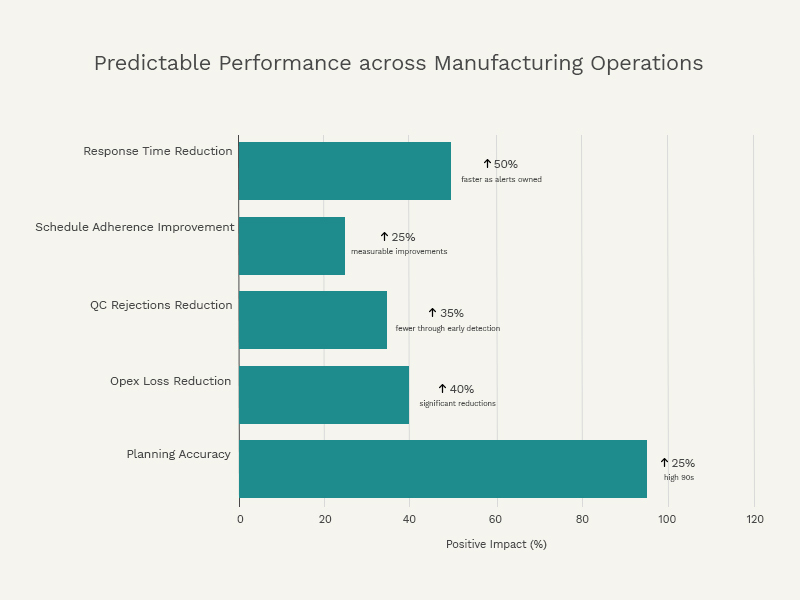
Planning accuracy reaches the high 90s
Significant reductions in waste-driven Opex loss
Fewer QC rejections through early detection
Measurable improvements in schedule adherence
Faster response times as alerts become owned actions
What this really delivers is operational confidence, fewer escalations and more predictable performance across shifts, lines, and plants.
That’s the difference between AI that looks promising in strategy decks and AI that quietly strengthens execution at scale.
The foundation of industrial intelligence
Most manufacturers already have the data they need. It’s just scattered.
Planning, production, quality, maintenance, and supply chain systems each tell part of the story. But when those signals stay isolated, decisions often become reactive and disconnected. Teams optimize locally, issues surface late, and leadership reviews results after value is already lost.
Industrial AI works when it brings these signals together into a single, real-time operational picture. Not another reporting layer, but a live view that connects intent, execution, and outcome.
With that foundation, AI can surface risks early, explain why they’re forming, and support better decisions while there’s still time to act. Just as importantly, everyone, from plant teams to executive leadership, operates from the same version of the truth.
That unified view becomes the foundation for AI that actually works across five core production realities.
1. Planning that adapts in real time
Traditional manufacturing planning assumes stability, even though enterprise operations rarely experience it. Demand shifts mid-cycle, supplier performance fluctuates, and capacity changes line by line, which means that by the time plans are reviewed, teams are often reacting to missed commitments or excess inventory rather than preventing them.
Planning starts to work when it moves from periodic coordination to continuous alignment with operational reality. Instead of locking plans based on historical averages and trends, leading manufacturers rely on a shared real-time planning intelligence layer that reconciles demand signals, live capacity, inventory positions, and supplier behavior as conditions change.
This allows plans to adjust before disruption, and the practical impact is simple:
Higher forecast accuracy
Fewer last-minute schedule changes
Better alignment between procurement, production, and fulfillment
- Greatly improved fulfillment reliability and order accuracy
TruMetric’s Plan Central uses AI to continuously align demand, capacity, inventory, and supplier performance so plans adjust as reality changes.
2. Early detection that protects throughput and quality
In most manufacturing environments, performance issues rarely appear all at once. They build gradually, through small process drifts, subtle changes in material behavior, or minor deviations in execution that go unnoticed.
Traditional monitoring approaches tend to surface these issues too late, often through lagging indicators or post-shift reports that explain what went wrong but offer little opportunity to prevent it.
When Industrial AI works, it continuously learns what “normal” looks like across products, lines, and operating conditions, allowing emerging deviations to be detected early and placed in context. Instead of flooding teams with alerts, it highlights the changes that matter, explains why they matter, and suggests corrections, giving operations a chance to intervene while outcomes can still be protected.
The outcome is more stable production, fewer downstream quality surprises, and less reactive escalation across teams.
TruMetric’s Signal Guard detects early process, quality, and equipment deviations in real time, before they turn into scrap, downtime, or missed deliveries.
3. Inventory that supports production
Inventory sits at the intersection of planning assumptions and production reality, which is why it so often becomes a source of both operational risk and financial inefficiency. Excess stock ties up capital and hides underlying problems, while shortages disrupt production and force costly expediting.
Inventory management becomes more effective when it is driven by a live understanding of demand, production behavior, and supply variability rather than static thresholds. With continuous visibility and predictive insight, risks surface earlier, replenishment decisions become more intentional, and inventory starts to support flow instead of compensating for uncertainty.
This shift helps organizations reduce working capital pressure without increasing the risk of line stoppages or missed commitments.
TruMetric’s Stock Guard predicts stockout and overstock risk using live consumption and demand signals, helping inventory support flow instead of firefighting.
4. Recall-ready intelligence for better visibility
Unplanned downtime remains one of the most expensive and disruptive challenges in manufacturing, not because failures are unpredictable, but because early signals are often buried across systems or overlooked until a breakdown occurs.
Maintenance teams are typically forced into reactive modes, responding to failures under pressure and competing for production windows, even though many of these events could have been anticipated with better visibility into equipment and process behavior.
Industrial AI changes this dynamic by continuously analyzing operational signals to identify patterns that precede failure, allowing maintenance work to be planned rather than rushed. When reliability insights are connected directly to production context, interventions can be scheduled with minimal disruption, improving asset performance without increasing workload.
Over time, this leads to more predictable output, fewer emergency interventions, and a more stable operating environment across shifts and plants.
TruMetric’s Trace Central provides real-time, end-to-end traceability so teams can assess impact, contain risk, and respond faster when issues arise.
5. Knowledge that stays with the operation
A surprising amount of operational disruption in manufacturing environments has nothing to do with machines. It comes from missing context because teams operate from different data, timelines, and interpretations of reality. You see it in everyday questions:
Which SOP applies here?
Why was this parameter changed last time?
Who owns this issue on the next shift?
When that context lives in scattered documents, personal notes, or tribal knowledge, decisions slow down. Teams spend time debating information instead of resolving the issue in front of them.
AI-powered knowledge hubs create a shared, real-time operational picture that connects intent, execution, and outcome across the enterprise. This alignment reduces debate over numbers and shifts focus toward action, accountability, and prioritization.
Platforms like DocuTrust centralize documents, workflows, and process knowledge into a governed repository with version control, audit trails, and natural-language search. This ensures that everyone works from the same trusted source while maintaining full visibility into ownership, approvals, and process history.
What this means operationally is that the knowledge behind the process stays with the organization, not with individuals. Teams move faster, shift handoffs become cleaner, and decisions focus on action instead of interpretation.
Why services matter as much as software
One reason Industrial AI fails is the belief that software alone will fix messy reality.
Data needs work, processes need alignment, and teams need trust in the outputs.
AI works when it is paired with services that help manufacturers:
Define a clear operational visibility roadmap
Build a reliable data foundation
Customize models to real operating conditions
Scale from pilot to plant-wide deployment
Success occurs when a plan is created up front on Pilot & beyond pilot deployment. When only the Pilot is planned, it creates an AI silo that a high % of companies don't get past.
This “pilot to production” discipline is what separates meaningful outcomes from endless experimentation.
Final thoughts
As AI becomes embedded in daily operations, manufacturing will move from reacting to events to anticipating them as a matter of course.
This future isn’t about autonomous factories or removing people from the equation. It’s about giving teams a clearer view of reality and the confidence to act before small issues become systemic problems.
For manufacturers facing tight margins and constant volatility, this shift defines the next era of operational excellence: not AI as a project or promise, but as a quiet, embedded capability that steadily raises performance across the entire operation.
From production lines and quality systems to supply chains, customer fulfillment, and the boardroom dashboards that guide strategic decisions, AI becomes part of the daily operating rhythm. When every team is working from the same integrated operational view, decisions move faster, disruptions surface earlier, and performance improves across plants, partners, and markets.