
Chatbots, AI Agents, Agentic AI: Same or Different?

Chatbots, AI Agents, and Agentic AI - sound similar? They do, but they’re not. Learn how they differ, and each of them powers automation and adds to your business benefit.
Imagine landing on a website, unsure of where to start. A chatbot pops up - ready to guide you, answer your questions, and help you figure out exactly what you need. The process feels structured. The direction is clear.
Now, imagine a step further. Say, that chatbot could think, plan, and act - like your digital buddy who understands your request as well as responds with the steps to fulfill it. That’s an AI Agent at work.
Chatbots offer basic support with quick solutions. AI Agents make decisions and execute complicated queries. Agentic AI emerges when a network of AI agents learn, adapts, and works in concert to achieve complex business objectives that a single agent could not accomplish alone.
So, chatbots respond, AI Agents act, and Agentic AI orchestrates.
Learn how the three differ, how Agentic AI builds on AI Agents, and when to use each to make the right call for your automation strategy.
They’re not the same - here’s how they differ
Although “chatbots,” “AI agents,” and “Agentic AI” may seem synonymous, they’re not. In reality, each of them represents different levels of intelligence and autonomy.
- Chatbots are rule-based responders that react to user inputs within fixed limits.
- AI Agents are autonomous entities that can reason, plan, and execute actions toward a specific goal.
- Agentic AI is an evolved system where multiple AI agents collaborate intelligently to achieve outcomes, often without direct human intervention.
What are Chatbots?
A chatbot is your assistant working through a set script. It’s helpful, predictable, but limited in scope.
Here’s how a chatbot works and where its scope of work is limited:
- Reactive and scripted: Chatbots respond within predefined rules. You can ask unexpected things to check how they won’t respond as expected.
- Context-blind: It carries no memory or continuity of previous chats. Repetitive interactions frustrate users.
- Single-purpose: Traditional chatbots cannot connect with CRMs, analytics tools, or other business systems, and they operate in silos.
- High maintenance: Chatbots require coding and constant updates to expand their capabilities.
Chatbots do a great job of handling frequently asked questions, simple tasks, and basic support. They are best suited for high volume but lack real intelligence.
Example: Customer Support Chatbot
User: "What are your business hours?"
Chatbot: "We're open Monday-Friday, 9 AM to 6 PM EST. How else can I help you today?"
User: "Do you ship internationally?"
Chatbot: "Yes, we ship to over 50 countries. Shipping costs vary by location. Would you like to know the cost for a specific country?"
How can Chatbots help your business?
Chatbots are meant to do simple tasks that make your business workflow easier. Here’s how you can get the most out of a chatbot:
- Serve as a stepping-stone for automation: Chatbots make sense in handling low complexity tasks. It buys you time while you build toward more advanced agentic automation.
- Keep things predictable and maintainable: Chatbots follow scripts, are easier to manage for simple tasks, and require fewer integrations.
- Offer 24/7 basic responsiveness: They’re available 24/7 and cover beyond human hours, which is great for quick starts.
- Handle high-volume simple tasks: Chatbots can answer FAQs, track orders, and provide initial customer support. Their scope of work is standard and repeatable.
What are AI Agents?
An AI agent acts like a digital employee. They check off the qualities - intelligent, proactive, and can work independently.
Unlike traditional chatbots, AI agents comprehend the objectives and make decisions to fulfill them.
For example, an AI sales agent doesn’t just provide you with service details. It identifies your requirements, follows up, books meetings, and updates the CRM automatically.
Here’s what defines AI Agents:
- Autonomy: They decide and act without constant supervision.
- Goal orientation: Each agent is created to fulfill a specific purpose (like lead qualification or customer onboarding).
- Reasoning and planning: Agents break down complex queries into smaller tasks to execute them systematically.
- Learning ability: They evolve over time using data and user interactions.
In short, AI Agents bring true cognitive automation and don’t wait for commands; they move toward results.
Example: Personal Assistant Agent
User: "Schedule a meeting with the marketing team for next Tuesday afternoon."
Agent Actions:
- Checks calendar for next Tuesday afternoon availability
- Identifies marketing team members from contacts
- Finds a time slot when all members are free (2 PM)
- Creates a calendar event and sends invitations
- Reserves the conference room automatically
Agent: "Done! I've scheduled a meeting with the marketing team for Tuesday, November 12, at 2 PM in Conference Room B. All 5 team members have been invited."
How can AI Agents impact your business process?
We spoke about how AI Agent simplifies automation and drives you towards results. How do they do that?
- Scale smarter while cutting costs: AI Agents are built to grow, learn, and self-improve. Low-code or no-code entry points for non-technical teams simplify things while autonomous workflows free up human time for strategy.
- Fuel smarter decision-making: An AI Agent gathers real-time insight, adaptive strategies, and works on resilient operations. It becomes your strategist-analyst-executor all in one.
- Elevate the customer experience: AI Agents remember past interactions, adapt on the fly, hands off to humans with full context, and even anticipates issues like delayed orders. This helps the customer feel heard and accounted for.
- Drive productivity and efficiency at scale: Your system can now act more than simply responding. The AI agent can demand predictions, route optimisations, supplier ordering, and complete end-to-end tasks.
What is Agentic AI?
When the new age of chatbots meets Agentic AI, it takes automation to the next level. Instead of simply responding to commands, Agentic AI lets you plan, reason, and execute complex, multi-step tasks automatically.
Think of it as a network of intelligent digital agents working together to drive your business goals forward. Here’s what you can expect as advantages of Agentic AI:
- Proactive and goal-driven - The AI identifies objectives, breaks them down to execute independently.
- Context-aware and adaptive - It can store memories of past interactions and allows you to continue in the next chat, adapting to new data.
- System-integrated - You can connect across multiple systems and tools like CRMs, APIs, and databases to gather information in real time and perform actions.
- Self-learning - Agentic AI utilizes feedback loops. It improves performance without manual intervention.
- Built for complexity - Run marketing campaigns, manage supply chains, and monitor industrial assets with Agentic AI’s multi-step, dynamic workflows.
Just when you struggle with the limited scope of chatbots, Agentic AI steps in to make an impact.
Supply Chain Optimization Example
Scenario: A manufacturing company's Agentic AI system detects a potential supply chain disruption.
Step 1 - Detection Agent: Monitors supplier feeds and identifies that a key component supplier in Taiwan is experiencing a typhoon, causing a 2-week production halt.
Step 2 - Analysis Agent: Analyzes inventory levels and determines that the current stock will run out in 10 days, potentially stopping production lines and affecting 3 major customer orders.
Step 3 - Sourcing Agent: Automatically searches alternative supplier databases, identifies 2 qualified backup suppliers in South Korea and Japan with available capacity.
Step 4 - Negotiation Agent: Initiates automated procurement requests, compares pricing and lead times, and places an expedited order with the optimal supplier.
Step 5 - Logistics Agent: Reroutes shipping to expedited air freight instead of standard sea freight, updates delivery schedules, and adjusts warehouse receiving plans.
Step 6 - Communication Agent: Sends proactive notifications to affected customers with revised delivery timelines, automatically offers compensation options, and updates internal stakeholders.
Step 7 - Financial Agent: Calculates cost implications, reallocates budget from contingency funds, and updates financial forecasts.
Step 8 - Learning Agent: Documents the disruption event, analyzes the response effectiveness, and updates risk models to improve future supplier diversification strategies.
Outcome: The entire process completes in 4 hours without human intervention, preventing a production shutdown, maintaining customer commitments with minimal delay, and saving an estimated $2.3M in lost revenue and expedite fees compared to manual response time.
How can Agentic AI transform your business?
If you want your business to move beyond the simple automation of chatbots, Agentic AI is what you need. It delivers measurable advantages across efficiency, customer experience, and decision-making. Examples of how Agentic AI can transform your business:
Upscale productivity and efficiency
Unlike chatbots, Agentic AI manages workflows end-to-end.
Treat it like your agent. In a supply chain, it can predict demand, optimize delivery routes based on real-time conditions, and place supplier orders automatically. You’re not just leveraging automation, but also autonomous operations.
Reduce or eliminate time required for repetitive manual tasks and gain more time for strategic, high-impact work.
Improve customer experience
With Agentic AI, it’s more than simply answering questions; agents understand users.
- Contextual and personalized - It remembers past interactions and tailors its responses for the customer.
- Seamless handoffs - If a human agent is needed, an agentic system provides a comprehensive summary of the conversation and relevant data. This ensures a seamless transition, so the customer never has to repeat themselves.
- Proactive engagement - It can anticipate a customer’s needs, like notifying them about a delayed order and offering a solution before they even ask or complain.
This level of intelligence results in smoother, more rewarding customer interactions.
Make smarter decisions driven by data
Agentic AI is perfect for turning data into action.
- Real-time insights - Analyze multiple data sources in real time, enabling smarter, data-driven decisions.
- Adaptive strategies - Optimize marketing campaigns, operations, or workflows based on real-time performance data.
- Resilient operations - When unexpected events occur, Agentic AI can adapt in real time without disrupting ongoing processes.
Think of it as your strategist, analyst, and executor - all rolled into one!
Scale smarter and reduce costs
While chatbots require constant updates to grow, Agentic AI can learn and scale automatically:
- Built for growth - Expand capabilities without manual reprogramming.
- Accessible to all - Use low-code or no-code tools and simplify automation for non-technical teams.
- Optimized resources - With Agentic AI’s autonomous workflows, you can deliver cost efficiencies, accelerate processes, and maximize ROI.
Embrace transformation with intelligent automation that evolves over time - becoming smarter and more efficient with every step.
When to use what?
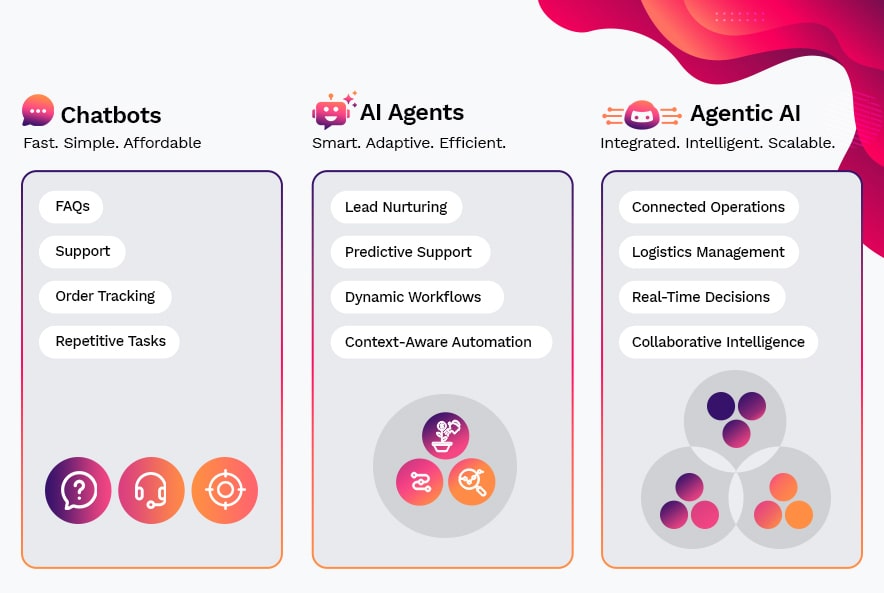
Each technology has its place depending on your business goals and complexity:
- Use Chatbots when your needs are basic - answering FAQs, offering support on websites, or handling repetitive service queries. They’re cost-effective and quick to deploy.
- Use AI Agents when you need automation with intelligence - like automating lead nurturing, running predictive support systems, or managing dynamic workflows that require reasoning.
- Use Agentic AI when your operations demand complex orchestration across multiple systems - like managing logistics, automating marketing across platforms, or powering real-time decision-making across departments.
In short:
- Chatbots → respond
- AI Agents → act
- Agentic AI → collaborate and optimize
The right choice depends on the depth of automation and autonomy you want your systems to achieve.
Final thoughts
Chatbots can only handle basic interactions. But today’s businesses need AI that goes beyond responding and can think, plan, and act intuitively. AI Agents bridge this gap. They respond, reason, learn, and execute tasks independently, driving your operations toward real outcomes.
And when these agents collaborate through Agentic AI, they can manage complex workflows, adapt with your real-time business goals, and deliver measurable results. That’s how you boost efficiency, customer satisfaction, and make smarter decisions.